 English
 Español
 Français
 עברית
 Português


Buying property in Costa Rica as a Canadian is surprisingly straightforward. Canada and Costa Rica have no bilateral treaty restricting foreign ownership, so you have exactly the same property rights as a Costa Rican citizen the moment you close. You can own titled land outright in your name, hold it through a Costa Rican corporation (a sociedad anónima, or S.A.), or buy through a trust. No residency required, no special permit, no government approval. That said, the process has real traps, especially around maritime zone land, title gaps, and municipal taxes, that catch buyers who assume Costa Rica works like Canada. Here’s what you actually need to know before you wire a deposit.
- Canadians can own titled Costa Rican property outright, with no restrictions compared to local buyers.
- The public registry (Registro Nacional) is the legal record of ownership, not a deed in a filing cabinet.
- Maritime zone land near the beach works under a concession system, not fee-simple title, and requires extra due diligence.
- Always run a property check and order the full title report before signing any purchase agreement.
Do Canadians Have the Right to Own Property in Costa Rica?
Yes, fully and without restriction. The Costa Rican constitution grants foreigners the same property rights as nationals. That’s not marketing language. It’s written into law, and it’s enforced. You’ll see your name, or your corporation’s name, registered in the Registro Nacional, which is the country’s public registry and the only record that matters legally. A Costa Rican deed (called an escritura pública) becomes binding when a licensed notary inscribes it in that registry.
The one area where foreigners face restrictions is maritime zone land, and that applies to everyone, including Costa Ricans. More on that below.
How Does the Purchase Process Work?
It’s not like buying a condo in Toronto. There are no real estate boards setting standard contract forms, no land transfer tax rebates, and no five-day cooling-off periods by default. Here’s the basic sequence.
Step 1: Find the property and do preliminary research
Before you offer anything, run a property check on Folio to pull the finca number (the parcel’s registry ID), the lot area, and the boundary map. That takes seconds and costs nothing. It tells you whether the land parcel actually matches what the seller is showing you on a site map.
Step 2: Sign a purchase agreement and pay a deposit
Once you agree on price, you’ll sign an Opción de Compra (option to buy) or a Promesa de Compraventa (promise to sell). These are legally binding in Costa Rica. A typical earnest deposit runs 10 percent and is held in escrow, usually by a Costa Rican attorney or a licensed escrow company. Never wire a deposit directly to a seller or an unlicensed agent.
Step 3: Due diligence period
Your attorney will order a full title study. This covers ownership history, liens, mortgages, annotations, and any encumbrances registered against the finca. If you want to verify all of that yourself before meeting with your lawyer, order a $29 Folio report, which is human-reviewed and covers ownership, liens, encumbrances, mortgages, and annotations, delivered within 24 hours. That gives you a plain-English picture before your attorney digs into the full legal chain.
Step 4: Closing
Closing happens before a Costa Rican notary public. Your attorney prepares the escritura pública (public deed), both parties sign, and the notary files it with the Registro Nacional. Funds typically move through escrow and release once inscription is confirmed. The whole process, from signed agreement to registered title, usually takes 30 to 60 days for a clean transaction.
Closing costs in Costa Rica run higher than most Canadians expect. Use the free REG closing cost calculator to estimate what you’ll owe before you finalize your offer. Transfer taxes, registry stamps, and notary fees are split between buyer and seller by custom, but that split is negotiable.
What Is the Maritime Zone and Why Does It Matter for Canadians Buying Property in Costa Rica?
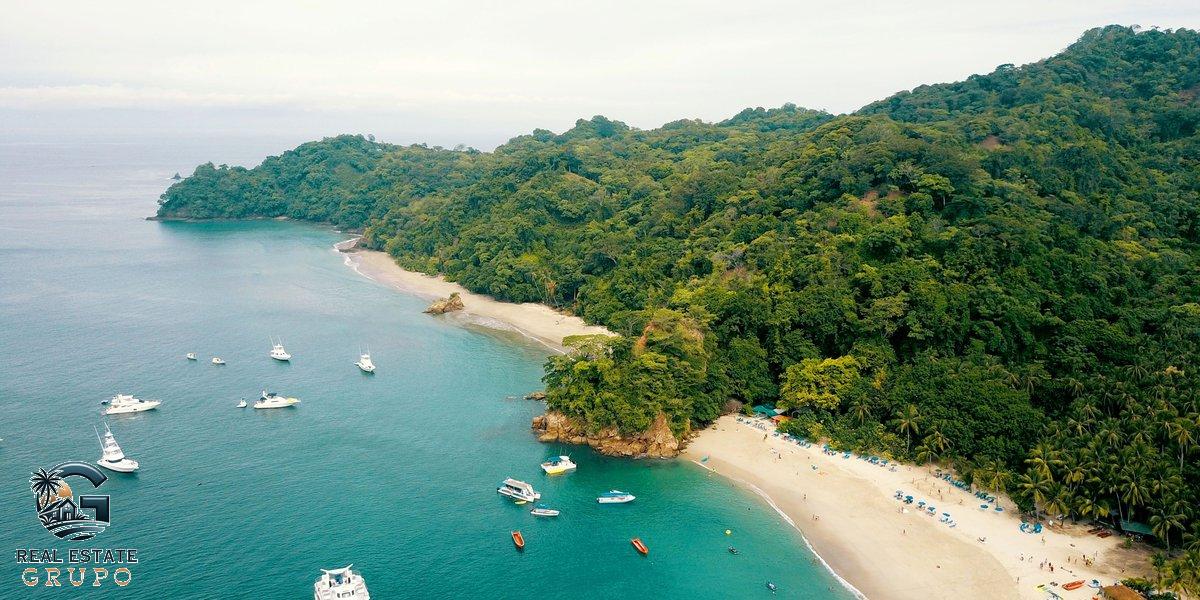
This is the number-one trap for beach buyers. Costa Rica’s Maritime Zone Law reserves the first 200 meters from the high-tide line as public land. The first 50 meters is always public, with no private ownership allowed, ever. The next 150 meters is concession land, meaning the government grants a right to use and develop it, but you don’t actually own the soil beneath your feet.
Concessions are issued by the local municipality and monitored by ICT (the Costa Rican Tourism Institute). A concession can expire, can be revoked, and cannot be held by a foreigner who has lived in Costa Rica for fewer than five years. If you’re buying a beachfront property in a concession zone, you’ll need a Costa Rican partner with the legal right to hold it, or a corporation with qualifying shareholders. This is not a reason to avoid beach property. Thousands of Canadians hold concessions legally. It’s a reason to get the structure right from day one.
Inland titled properties, in areas like the Central Valley, Lake Arenal, the Southern Zone, or Guanacaste highlands, don’t have this complication. Title is title.
Taxes and Ongoing Costs Canadian Buyers Should Know
Costa Rica has no capital gains tax on the sale of real property for most individual sellers (though rules can change, and your tax situation in Canada may still create reporting obligations back home). You will pay:
- Municipal property tax (impuesto de bienes inmuebles): Roughly 0.25 percent of the declared property value per year, paid to the local municipality. Very low compared to Canadian property taxes.
- Luxury home tax (impuesto solidario): An annual tax on residential properties whose construction value exceeds a threshold set by Hacienda (the Costa Rican treasury). If your home is high-value, budget for this.
- HOA fees: Common in gated communities and condos. Ask for 12 months of financials before you buy into any development.
- Canadian tax obligations: As a Canadian resident buying foreign property, you have reporting duties to the CRA. Talk to a cross-border tax accountant. This is not optional.
Financing Options for Canadian Buyers
Canadian banks won’t mortgage a Costa Rican property. Full stop. Local Costa Rican banks will lend to foreigners, but underwriting requirements are significant and interest rates run higher than you’d expect from a Canadian perspective. The practical result is that most Canadian buyers either pay cash or negotiate seller financing.
Owner financing (called financiamiento del vendedor) is genuinely common in Costa Rica, more so than in Canada. Sellers who own their land free and clear will often carry the note at agreed terms. Use the REG owner financing calculator to model different down payments, interest rates, and terms before you sit down at the table.
Titled vs. Concession Land: A Quick Comparison
| Feature | Fee-Simple Titled Land | Maritime Zone Concession |
|---|---|---|
| Ownership type | Full private ownership | Government-granted right of use |
| Can a foreigner hold it? | Yes, without restriction | Only if qualified under Maritime Zone Law |
| Registered in Registro Nacional? | Yes | Registered with the municipality and ICT |
| Can it be mortgaged? | Yes | Rarely, and with significant restrictions |
| Common locations | Central Valley, highlands, inland towns | Within 200m of ocean high-tide line |
Should You Buy in a Corporation?
Many Canadians hold Costa Rican property through a sociedad anónima (S.A.) or a sociedad de responsabilidad limitada (S.R.L., similar to an LLC). The main practical reason is liability separation. If someone slips on your rental property and sues, they’re suing the corporation, not you personally. There’s also the estate planning angle. Transferring shares of a Costa Rican corporation can be simpler than re-registering real property when ownership changes hands.
The downside is ongoing compliance. Costa Rican corporations must file an annual beneficial owner declaration with the Registro Nacional, pay annual corporate taxes, and keep proper minutes. If you let those lapse, the corporation can be dissolved. Work with a Costa Rican attorney who handles annual corporate maintenance, not just the initial setup.
Thinking About Renting Your Property?
Short-term vacation rentals are legal and popular in Costa Rica, especially in beach communities like Tamarindo, Manuel Antonio, and the Osa Peninsula, as well as mountain areas like Monteverde. If you’re buying with rental income as part of the plan, model the numbers before you fall in love with any particular property. The REG rental ROI calculator lets you plug in purchase price, expected occupancy, and nightly rate to see realistic returns. Occupancy is seasonal and highly location-dependent, so be honest with your assumptions.
Frequently Asked Questions
Do I need to be a resident of Costa Rica to buy property there?
No. You can buy titled property in Costa Rica as a non-resident Canadian with a valid passport. Residency is not required for ownership. It becomes relevant only if you want to hold a maritime zone concession directly in your name, where a minimum residency period applies.
Can I get a mortgage in Costa Rica as a Canadian citizen?
Local Costa Rican banks do lend to foreigners, but qualifying is harder than in Canada and rates are generally higher. Most Canadian buyers pay cash or negotiate owner financing with the seller. If you’re exploring financing, use the owner financing calculator to compare scenarios.
What is a finca number and why do I need it?
A finca number is the parcel’s unique ID in the Registro Nacional. Every piece of titled land in Costa Rica has one. You need it to verify that the property being sold actually matches the registered parcel, and to check for liens, encumbrances, or boundary issues. You can find a parcel’s finca number on Folio’s free map in seconds.
Are there any restrictions on what I can build on my Costa Rican property?
Yes, depending on the location. Properties near rivers, wetlands, or protected areas have setback rules and may require environmental permits from SETENA. Municipal zoning also controls land use. Always confirm permitted use and any environmental restrictions with your attorney before signing, not after.
How do I know if a property has clean title?
You verify through the Registro Nacional. Your attorney will run a full title study going back through the ownership chain. For a plain-English summary before that formal study, order a $29 Folio report at foliocostarica.com, which covers ownership, liens, encumbrances, mortgages, and annotations, reviewed by a human and delivered within 24 hours. Don’t skip this step, even on properties that look straightforward.
Browse available properties across Costa Rica on the REG listings page, or reach out to the team directly at the contact page with specific questions about locations, budgets, or property types.
Want a straight answer from a local team? Message Leo on WhatsApp at +506 8798 6122.
Browse current Costa Rica listings
These are properties we are working with right now. New ones get added often, so check back, or message us for off-market options that never hit the public site.

5 bedrooms / 5 bathrooms
Puntarenas Province, Santa Teresa, Costa Rica
CASA CEDRO | MAL PAIS
Puntarenas Province, Santa Teresa, Costa Rica
CASA MAREA with $400,000 down
Malpais, Puntarenas Province, Costa Rica
San Isidro Cóbano
Puntarenas Province, Santa Teresa, Costa Rica
Beachfront Villa in Playa Mal País
Puntarenas Province, Santa Teresa, Costa Rica
heart of Santa Teresa
Puntarenas Province, Santa Teresa, Costa RicaOn the ground in Costa Rica, helping US and Canadian buyers find and safely close the right property. Questions? Message Leo on WhatsApp at +506 8798 6122.


Join The Discussion