 English
 Español
 Français
 עברית
עברית Português

Playa hermosa costa rica real estate attracts a specific kind of buyer: someone who wants a quieter, more authentic Pacific beach town without paying Tamarindo prices or dealing with Tamarindo crowds. Playa Hermosa sits roughly 30 minutes south of Liberia’s international airport in Guanacaste, and it delivers on the promise of a surf-friendly, low-key lifestyle with a genuine local community still intact. Prices here are meaningfully lower than the more developed spots to the north, but that gap is narrowing. If you’ve been watching this area, the window of relative value is still open, though not as wide as it was five years ago. Here’s what you actually need to know before you make a move.
- Playa Hermosa is a genuine surf town in Guanacaste, about 30 minutes from Liberia airport, with a lower entry price than neighboring Tamarindo or Flamingo.
- Much of the beachfront land sits inside the Maritime Zone (Zona Marítimo Terrestre), which means concession rights, not titled ownership. Knowing the difference is critical.
- Titled properties just inland from the beach carry cleaner ownership and are often the better buy for foreign investors.
- Infrastructure is improving but still developing. Paved roads, water availability, and SETENA environmental permits all need due diligence.
Where exactly is Playa Hermosa and why do buyers choose it?
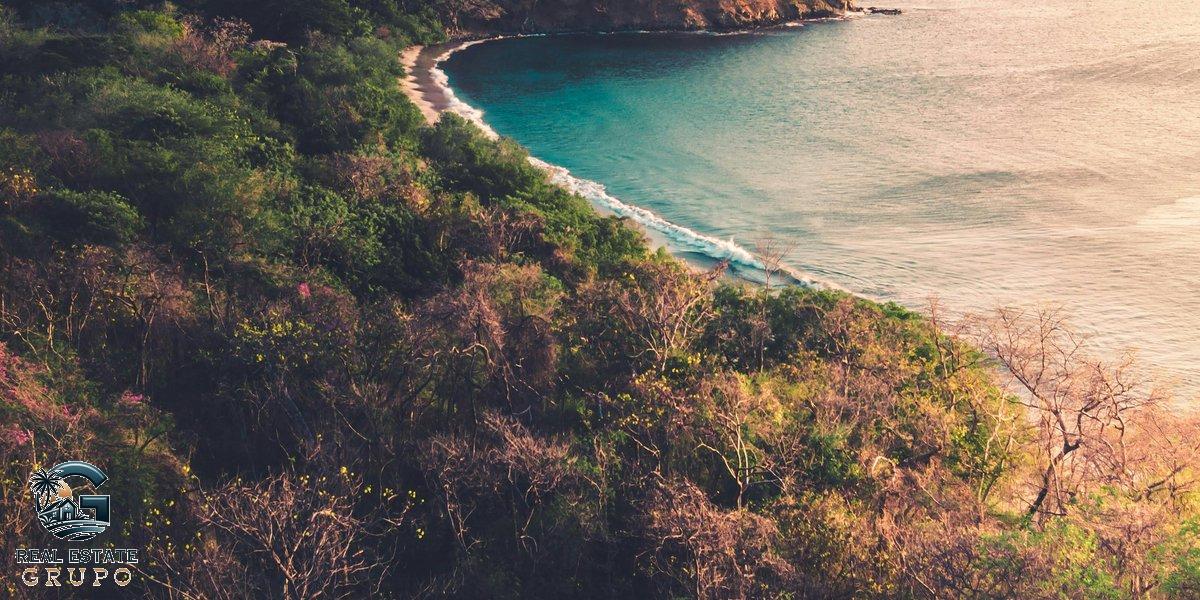
Playa Hermosa (not to be confused with the Playa Hermosa near Jacó on the Central Pacific) sits just south of Playa del Coco in Guanacaste’s Papagayo region. The beach itself is a dark-sand surf break, consistently rated one of the better waves in the region. That keeps it popular with serious surfers but also naturally filters out the party-crowd tourism that has transformed some neighboring towns.
The town has a small cluster of restaurants, surf shops, and short-term rentals, but no large hotel chains and no strip malls. For buyers, that’s a feature, not a bug. It means the character of the place is still shaped by the people who live there year-round, both Tico (Costa Rican local) and expat.
Proximity to Liberia’s Daniel Oduber Quirós International Airport is a real practical advantage. You can land, clear customs, and be sitting on the beach in under an hour, which matters a lot for vacation-home buyers who want to maximize time, not commute.
What types of property are available in Playa Hermosa Costa Rica real estate?
You’ll find four main categories here: beachfront concession land, titled residential lots set back from the beach, existing homes and villas (some with rental income history), and the occasional small commercial property aimed at tourism operators.
| Property Type | Ownership Structure | Who It Suits |
|---|---|---|
| Beachfront concession land | Concession rights (not title), managed by municipality | Experienced investors, operators with legal support |
| Titled residential lot | Full fee-simple title, registered in the Registro Nacional | Most foreign buyers and investors |
| Existing home or villa | Titled (verify structure is on same folio as land) | Buyers wanting rental income or immediate use |
| Small commercial property | Titled or concession depending on location | Hospitality or tourism business buyers |
The titled residential lots a few hundred meters from the shore are where most of our buyers at Real Estate Grupo end up. You get clean ownership, easier financing options, and none of the municipal renewal headaches that come with concession land.
What is the Maritime Zone and how does it affect beachfront buying?

This is the most misunderstood part of buying near any Costa Rican beach, and Playa Hermosa is no exception. Under the Maritime Zone Law (Ley de la Zona Marítimo Terrestre), the first 200 meters from the high-tide line is divided into a public zone (the first 50 meters, which nobody can own or build on) and a restricted zone (the next 150 meters, which can only be held via concession, a government-granted use permit).
Foreigners who have not been legal residents of Costa Rica for at least five years cannot hold a concession directly in their name. That’s a hard legal limit. Some buyers structure ownership through a Costa Rican corporation with local partners, but that introduces complications that you need a qualified Costa Rican attorney to navigate properly before you sign anything.
The Costa Rican Tourism Institute (ICT) oversees tourism-related development in the Maritime Zone, and the local municipality (Carrillo canton covers Playa Hermosa) manages individual concessions. Concession status, annual fees, and renewal history should all be verified before any offer.
What do properties actually cost in Playa Hermosa?
Prices vary widely based on proximity to the beach, lot size, and whether there’s an existing structure. Broadly speaking, Playa Hermosa sits below the price levels of Tamarindo, Flamingo, and the luxury Papagayo peninsula developments to the north, which is a big part of its appeal for value-conscious buyers.
Titled lots set back from the beach typically start at entry-level prices accessible to buyers who couldn’t afford beachfront in more developed towns. Move-in-ready homes with pools and ocean views command meaningfully more. The top end of the market here is still far below what comparable properties cost in Nosara or Santa Teresa.
The biggest mistake I see buyers make is assuming that a lower price means less due diligence is needed. It’s actually the opposite. Properties in less developed markets sometimes carry unclear title history, unpermitted construction, or water-access issues that don’t show up on a casual visit.
Is Playa Hermosa a good rental market for investors?
Honest answer: it can be, but it’s not as deep a rental market as Tamarindo or Manuel Antonio. The visitor base skews toward surfers, budget travelers, and repeat expat visitors who know the area. That keeps nightly rates moderate rather than premium.
Where investors do well here is in the mid-range surf-and-stay category: a clean, well-equipped home within walking distance of the beach, managed professionally. Guanacaste’s dry season (roughly December through April) drives strong occupancy, and the surf crowd extends the shoulder season in a way that pure beach towns don’t always get.
If maximizing rental yield is your primary goal, set realistic expectations and talk to a property manager who actually operates in Playa Hermosa, not just in the broader Guanacaste region. The hyperlocal dynamics matter.
What does the buying process look like for a US or Canadian buyer?
Foreign buyers have the same property rights as Costa Rican citizens for titled property. That’s one of the genuinely buyer-friendly aspects of Costa Rica’s legal framework, and it’s one reason this country has attracted North American real estate investment for decades.
The standard process: find a property, agree on a price, hire a Costa Rican attorney (not the seller’s attorney), conduct due diligence on title, liens, permits, and taxes, sign a purchase-sale agreement (called a “promesa de compraventa”), pay a deposit, and close by transferring the property deed (the “escritura”) before a notary public. The notary in Costa Rica is also an attorney and plays a central role in the transfer.
Closing costs in Costa Rica are generally in the range of a few percent of the purchase price, split between buyer and seller by custom (though this is negotiable). Transfer taxes, stamps, and registration fees are paid to the government. Your attorney should give you a full breakdown before you commit.
Want to see what’s currently listed in the area? Browse available properties on our listings page to get a sense of the current inventory and price range.
What are the biggest due diligence risks in Playa Hermosa?
Water is the one that surprises buyers most. Playa Hermosa has had periods where municipal water supply was inconsistent, and some properties rely on private wells or ASADA (community water association) systems rather than AyA (the national water authority). You need to know what system serves the property and whether it’s reliable during the dry season.
Unpermitted construction is another common issue. A beautiful home that was built without proper CFIA (Costa Rican Federation of Engineers and Architects) permits or without SETENA environmental clearance can create headaches when you try to sell or expand later. Always ask for the construction permits and verify them.
Finally, road access. Some lots in the hills above Playa Hermosa are accessed via unpaved roads that become difficult in the rainy season (May through November). Four-wheel drive isn’t just a lifestyle perk here; it can be a genuine necessity for certain properties.
Frequently Asked Questions
Can US or Canadian citizens legally own property in Playa Hermosa?
Yes. For titled properties, foreign nationals have the same ownership rights as Costa Rican citizens. The restriction applies specifically to Maritime Zone concessions, where non-residents face legal limits on direct holding. For titled land set back from the beach, ownership is straightforward and registered with the Registro Nacional.
Do I need to be a Costa Rica resident to buy real estate there?
No. You can buy titled property as a non-resident foreigner. Residency is not a requirement for ownership. However, it does matter for certain financial and tax considerations, and if you’re looking at concession land specifically, residency status affects your legal options significantly.
How far is Playa Hermosa from Liberia airport?
Roughly 25 to 35 minutes by car depending on traffic and the exact location of your property. This is one of the shortest airport-to-beach drives in Guanacaste, which is a genuine lifestyle advantage for vacation-home owners flying in from North America.
Is Playa Hermosa safe for expats and vacation-home owners?
Generally yes. It’s a small, community-oriented town with a mix of local Tico families, long-term expats, and seasonal visitors. Like anywhere, basic precautions apply: secure your home properly, use a reputable property manager if you’re absent for long periods, and get to know your neighbors. The local character here is calmer than in more touristy towns.
What’s the difference between a titled property and a concession in Costa Rica?
A titled property is full fee-simple ownership, recorded in the Registro Nacional under a folio real number. A concession is a government-granted right to use land in the Maritime Zone, granted by the municipality, renewable periodically, and subject to specific rules and restrictions. Concessions can be transferred, but they are not ownership in the traditional sense, and the rules around who can hold them are stricter, especially for non-residents.
Ready to look at specific properties in Playa Hermosa? Browse current listings or get in touch with the Real Estate Grupo team to talk through what fits your budget and goals.
Want a straight answer from a local team? Message Leo on WhatsApp at +506 8798 6122.
Browse current Costa Rica listings
These are properties we are working with right now. New ones get added often, so check back, or message us for off-market options that never hit the public site.

Private Villa Compound with Expansion Potential — Playa Hermosa
Puntarenas Province, Playa Hermosa, Costa Rica
Luxury Jungle Retreat in Playa Hermosa
Puntarenas Province, Playa Hermosa, Costa Rica
Ocean View Land with House in Santiago
Playa Hermosa, Puntarenas Province, Puntarenas, Costa Rica
Ocean View Lot in Playa Hermosa
Puntarenas Province, Playa Hermosa, Costa Rica
Prime Opportunity in Playa Hermosa
Puntarenas Province, Playa Hermosa, Costa Rica
Commercial Building in Hermosa
Aparthotel Hermosa Paradise, detrás del Supermercado Luperon, Ruta Nacional Secundaria 159, Guanacaste Province, Playa Hermosa, Costa RicaOn the ground in Costa Rica, helping US and Canadian buyers find and safely close the right property. Questions? Message Leo on WhatsApp at +506 8798 6122.

Join The Discussion